

Genoa is the 6th largest city in Italy, and with its location on the sea, it’s an important port for Italy and a port stop for many cruise lines. It’s very easy to explore Genoa in a day by walking around to see the city. Here are some highlights of what to see, and maybe what to avoid.
Be sure to check official websites for operating hours and ticket prices for the different places you want to go. Don’t trust Google hours, they are not always accurate.

Genoa Aquarium is the largest aquarium in Europe and absolutely worth the trip. Expect to be there for at least 2 hours, or longer if it’s crowded. It is cheaper to buy tickets online in advance for a fixed date and time slot. If you can plan around the aquarium, it’s worth the discount. Otherwise, the flexible online ticket is more expensive than on site, but you do run the risk of not getting into the aquarium when you want if you buy at the door. (If you book a fixed date / time slot, you are only allowed to enter 30 minutes before your time slot, if it’s not crowded. If you arrive more than 30 minutes late, you might have to wait until the next available time slot to enter. Don’t be rude to the people working there – they can’t help you were early or late for your assigned time slot, and they are restricted by the computer system.)
Genoa Royal Palace (Palazzo Reale) is part of the UNESCO World Heritage Site and is located in the historic center known as “Palazzi dei Rolli”. There are 42 remaining palaces of the 106 palaces originally built in the late 16th century to the early 17th century as part of a “public lodging” plan where the residents were obligated to host visitors on behalf of the government. These palaces are still private residences, office buildings, or museums. If you haven’t gone into a palace before, it’s worth a visit to the Palazzo Reale, especially for the Hall of Mirrors. Be sure the check the website for hours of operation and ticket prices.
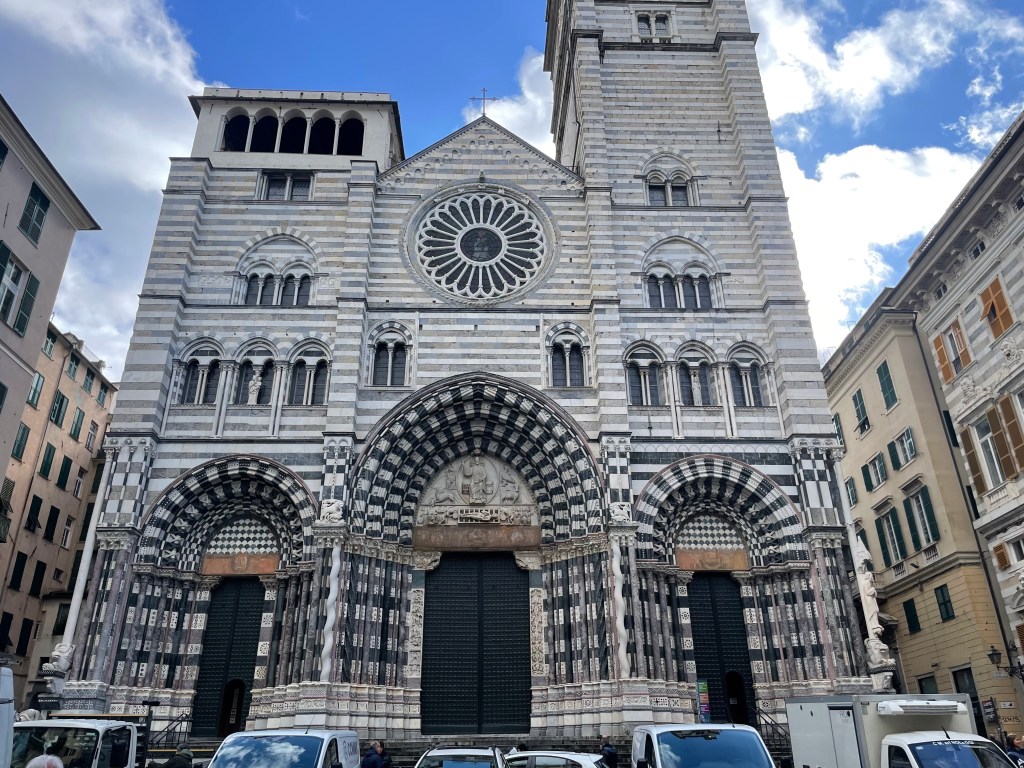
Cathedral of San Lorenzo (Genoa Cathedral) is so unique! The building construction started in the 11th century as a Roman Catholic cathedral dedicated to Saint Lawrence, and it is currently the seat of the Archbishop of Genoa. The gothic architecture and distinct black and white facade don’t disappoint.

Piazza Raffaele de Ferrari is the main square of Genoa, so it’s where many people meet together or big events take place, but on an daily basis, there’s nothing to do other than admire the buildings and the beautiful fountain. If you have time, pick up a snack, lunch or gelato to eat on the steps of the fountain. Otherwise, it’s cool to walk past and admire on your way to other attractions.

Casa di Colombo (Columbus’ House) is underwhelming. It was listed as a place to see from some websites, but we walked right past it and didn’t even realize it. The house isn’t the original; it was reconstructed in the 18th century. There is a museum inside, but we didn’t go. As we were looking for the house, we stumbled upon the Porta Soprana, also known as the Gate of St. Andrew, which a medieval gateway into the walled city build in the 11th century. The inscription on the wall says “I am defended by soldiers, surrounded by amazing walls, and with my strength I ward off the enemy’s darts. If you seek peace, you may touch these doors; if you seek war, you will return sad and defeated.”
Lighthouse of Genoa is about a 30-min drive from of the city. We didn’t have time to go see it, but it’s the world’s fourth oldest lighthouse and it is the main lighthouse for the Port of Genoa. The original tower was built in 1128. There is a museum inside with stories, history and artifacts of Genoa. You do have to pay to go inside the lighthouse.
Galata Maritime Museum is the largest maritime museum in the Mediterranean. If you are interested in sailing history, it might be worth your time. The museum houses several interactive rooms to help visitors understand what it meant to go to sea throughout history.
Villa del Principe (Palazzo del Principe) is another palace, but not as famous as the Royal Palace, nor as beautiful. You can walk through the gardens for free, but you have to pay to enter. The palace showcases the extravagance of the Renaissance era. If you haven’t seen a palace or if the Royal Palace is closed, this is another option to imagine what palace life would be like.
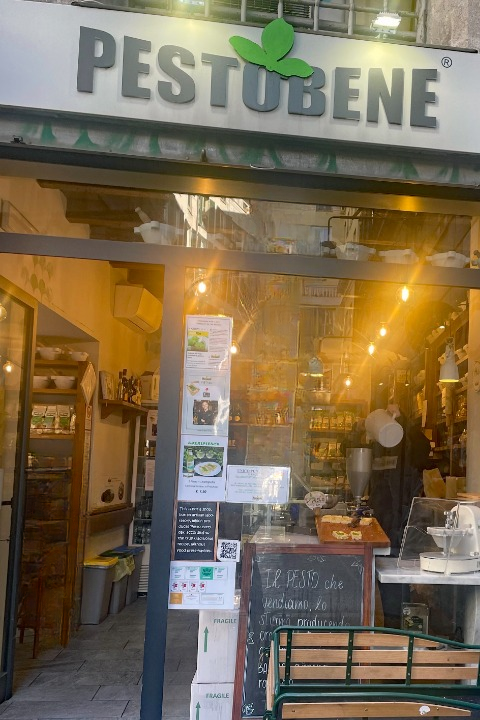
Pestobene is a small shop tucked away in an alley on Via San Pietro Della Porta, and it is the best place to get authentic pesto, gnocchi and focaccia. You don’t want to miss this cute little shop. The owner is very kind, and it’s worth the stop.
If you have time, there are plenty of other places you can see, depending on your own personal interests, so have fun and enjoy exploring… And don’t forget to try plenty of street food, pasta, wine, gelato, and other Italian foods.

 Traveling Tribe